Complete Guide to MERN Stack Development: Building Scalable Web Applications in 2025
Introduction: Understanding the MERN Stack
In the rapidly evolving world of web development, choosing the right technology stack is crucial for building successful applications. The MERN stack—comprising MongoDB, Express.js, React.js, and Node.js—has emerged as one of the most popular and powerful solutions for developing modern web applications.
AtPyramiqSoft, we specialize in MERN stack development, helping businesses create scalable, high-performance web applications that drive results. This comprehensive guide will explore everything you need to know about MERN stack development, from its components to best practices and real-world applications.
What is the MERN Stack?
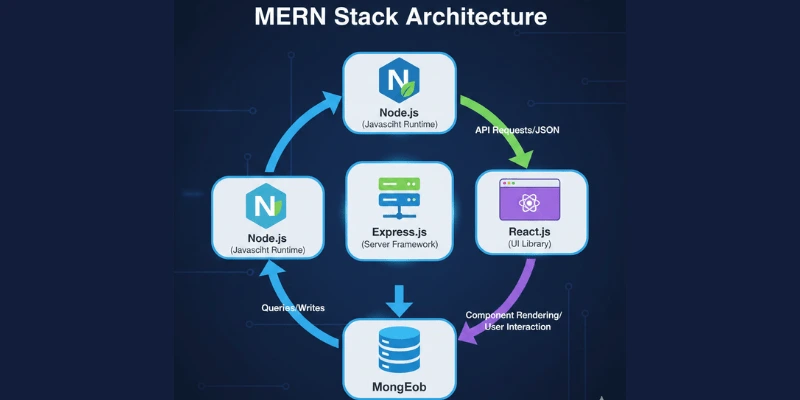
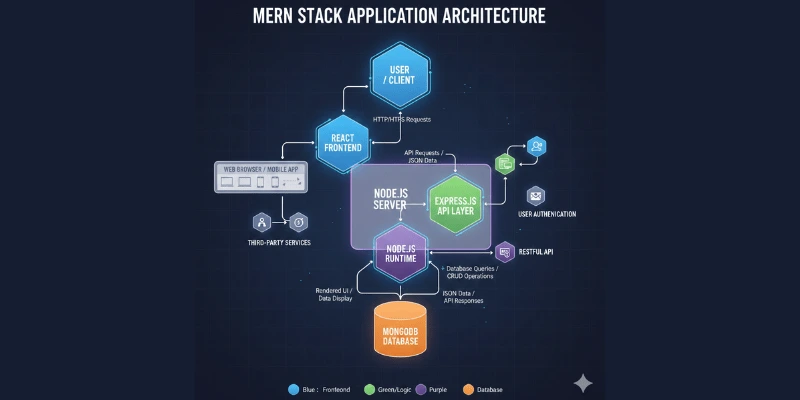
The MERN stack is a JavaScript-based technology stack used for building full-stack web applications. Each letter in MERN represents a key technology:
- M - MongoDB:A NoSQL database that stores data in flexible, JSON-like documents
- E - Express.js:A minimal and flexible Node.js web application framework
- R - React.js:A JavaScript library for building user interfaces, particularly single-page applications
- N - Node.js:A JavaScript runtime environment that executes JavaScript code outside a web browser
Together, these technologies create a powerful, end-to-end development solution that uses JavaScript throughout the entire application stack, making development more efficient and streamlined.
Why Choose MERN Stack for Your Project?
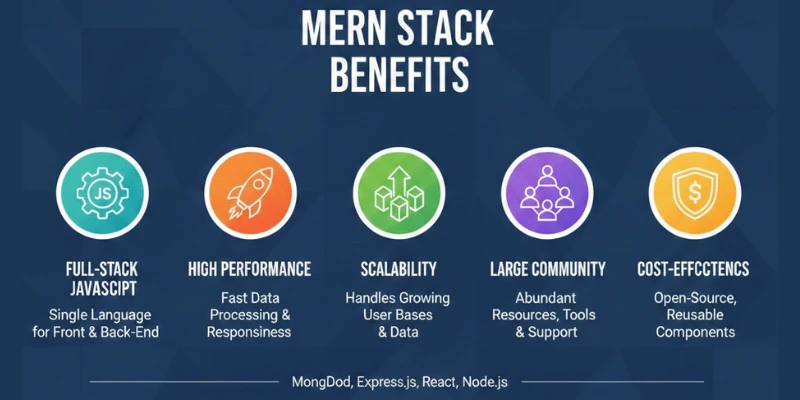
The MERN stack offers numerous advantages that make it an excellent choice for modern web development projects:
1. Full-Stack JavaScript
One of the biggest advantages of the MERN stack is that it uses JavaScript for both frontend and backend development. This means:
- Developers can work across the entire stack with a single programming language
- Code can be shared between frontend and backend, reducing duplication
- Easier team collaboration and knowledge transfer
- Faster development cycles
2. High Performance and Scalability
MERN stack applications are known for their excellent performance:
- Node.js:Built on Chrome's V8 engine, Node.js handles asynchronous operations efficiently, making it ideal for I/O-intensive applications
- React:Uses a virtual DOM for efficient rendering, resulting in fast user interfaces
- MongoDB:Handles large volumes of data and scales horizontally with sharding
3. Large Community and Ecosystem
Each technology in the MERN stack has a massive, active community:
- Extensive documentation and tutorials available
- Rich ecosystem of libraries and packages (npm has over 2 million packages)
- Active forums and communities for support
- Regular updates and improvements
4. Cost-Effective Development
MERN stack development can be more cost-effective because:
- All technologies are open-source and free to use
- Single language reduces development time and costs
- Large talent pool of JavaScript developers
- Reusable components and libraries
Deep Dive into MERN Stack Components
MongoDB: The Database Layer
MongoDB is a NoSQL document database that stores data in flexible, JSON-like documents called BSON (Binary JSON). Unlike traditional relational databases, MongoDB doesn't require a fixed schema, making it ideal for applications with evolving data requirements.
Key Features of MongoDB:
- Document-Based:Data is stored as documents, making it intuitive for developers
- Schema Flexibility:No need to define schema upfront; documents can have different structures
- Horizontal Scalability:Built-in sharding for distributing data across multiple servers
- Rich Query Language:Powerful querying capabilities with support for complex operations
- Indexing:Supports various indexing strategies for optimal query performance
- Replication:Built-in replication for high availability and data redundancy
When to Use MongoDB:
- Applications with rapidly changing data structures
- Content management systems
- Real-time analytics
- Mobile and social networking applications
- E-commerce platforms with diverse product catalogs
For businesses building e-commerce platforms or content-heavy applications, MongoDB's flexibility makes it an excellent choice. OurMERN stack development servicesat PyramiqSoft leverage MongoDB's capabilities to create scalable database solutions.
Express.js: The Backend Framework
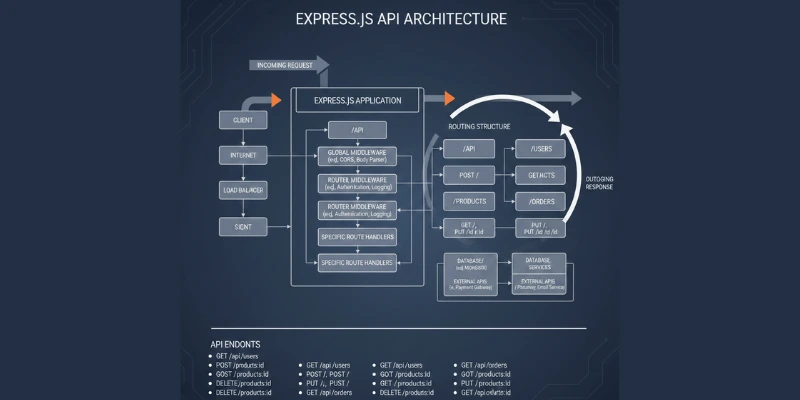
Express.js is a minimal, unopinionated web framework for Node.js that provides a robust set of features for building web and mobile applications. It simplifies server-side development by providing middleware, routing, and template engine support.
Key Features of Express.js:
- Middleware:Extensible middleware system for handling requests, responses, and errors
- Routing:Simple and flexible routing system for defining API endpoints
- Template Engines:Support for various template engines (though React typically handles views)
- Error Handling:Built-in error handling mechanisms
- HTTP Utilities:Methods and properties for handling HTTP requests and responses
Common Express.js Use Cases:
- RESTful API development
- Server-side rendering (when combined with template engines)
- Middleware for authentication, logging, and validation
- Microservices architecture
Best Practices for Express.js:
- Use middleware for cross-cutting concerns (authentication, logging, error handling)
- Organize routes in separate modules for better code organization
- Implement proper error handling middleware
- Use environment variables for configuration
- Implement rate limiting and security middleware
React.js: The Frontend Library
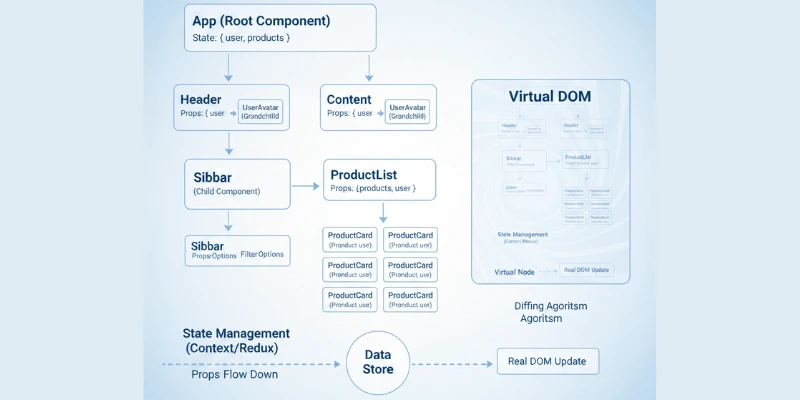
React.js is a declarative, efficient, and flexible JavaScript library for building user interfaces. Developed by Facebook, React has become the most popular frontend library, powering applications for companies like Netflix, Airbnb, and Instagram.
Key Features of React:
- Component-Based Architecture:Build encapsulated components that manage their own state
- Virtual DOM:Efficient rendering through a virtual representation of the DOM
- One-Way Data Binding:Predictable data flow from parent to child components
- JSX:Syntax extension that allows writing HTML-like code in JavaScript
- Hooks:Modern way to use state and lifecycle features in functional components
- Ecosystem:Rich ecosystem of libraries and tools (React Router, Redux, Next.js)
React Best Practices:
- Keep components small and focused on a single responsibility
- Use functional components with hooks instead of class components
- Implement proper state management (useState, useContext, or Redux)
- Optimize performance with React.memo, useMemo, and useCallback
- Follow component composition patterns
- Implement proper error boundaries
React's component-based architecture makes it ideal for building complex, interactive user interfaces. Ourweb development servicesleverage React to create engaging, performant frontends.
Node.js: The Runtime Environment
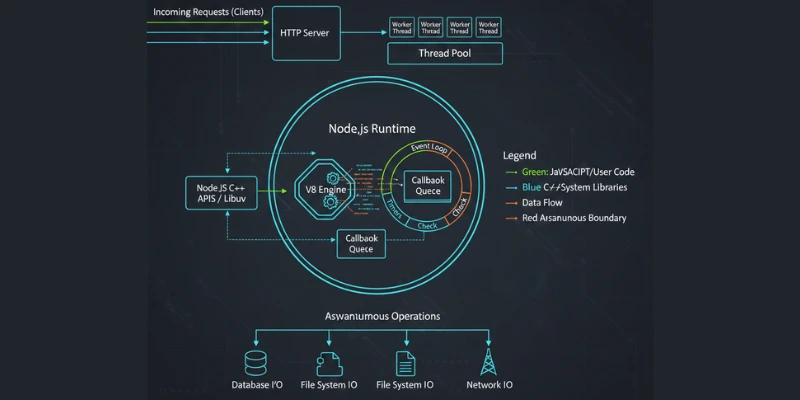
Node.js is a JavaScript runtime built on Chrome's V8 JavaScript engine. It allows developers to run JavaScript on the server side, enabling full-stack JavaScript development.
Key Features of Node.js:
- Asynchronous and Event-Driven:Non-blocking I/O operations for high performance
- Single-Threaded:Uses event loop for handling concurrent operations
- NPM Ecosystem:Access to millions of packages through npm
- Cross-Platform:Runs on Windows, macOS, and Linux
- Fast Execution:Built on V8 engine for fast JavaScript execution
Node.js Use Cases:
- Real-time applications (chat applications, gaming, collaboration tools)
- API servers and microservices
- Data streaming applications
- Command-line tools
- Desktop applications (with Electron)
Node.js Best Practices:
- Use async/await for handling asynchronous operations
- Implement proper error handling
- Use environment variables for configuration
- Implement logging and monitoring
- Use process managers like PM2 for production
- Implement security best practices
Building a MERN Stack Application: Step-by-Step
Now that we understand each component, let's explore the process of building a MERN stack application:
1. Project Setup and Structure
Organize your MERN stack project with a clear structure:
mern-app/
├── client/          # React frontend
│   ├── src/
│   ├── public/
│   └── package.json
├── server/          # Node.js/Express backend
│   ├── routes/
│   ├── models/
│   ├── controllers/
│   ├── middleware/
│   └── package.json
└── README.md
2. Backend Development (Node.js + Express + MongoDB)
Start by setting up your Express server:
- Initialize npm and install dependencies (express, mongoose, cors, dotenv, etc.)
- Create server.js file and set up Express app
- Connect to MongoDB using Mongoose
- Define data models/schemas
- Create API routes and controllers
- Implement authentication and authorization
- Add error handling middleware
3. Frontend Development (React)
Build your React frontend:
- Create React app using Create React App or Vite
- Set up routing with React Router
- Create reusable components
- Implement state management (useState, useContext, or Redux)
- Connect frontend to backend API
- Implement authentication flows
- Add error handling and loading states
4. Integration and Testing
Ensure seamless integration between frontend and backend:
- Test API endpoints
- Test frontend components and user flows
- Implement error handling
- Add input validation
- Test authentication and authorization
5. Deployment
Deploy your MERN stack application:
- Backend:Deploy to platforms like Heroku, AWS, DigitalOcean, or Railway
- Frontend:Deploy to Vercel, Netlify, or AWS S3 + CloudFront
- Database:Use MongoDB Atlas for cloud-hosted MongoDB
- Set up environment variables
- Configure CORS properly
- Implement monitoring and logging
Real-World Applications of MERN Stack
The MERN stack is versatile and can be used to build various types of applications:
E-Commerce Platforms
MERN stack is excellent for building e-commerce platforms due to:
- Scalability to handle large product catalogs
- Real-time inventory management
- Dynamic user interfaces for product browsing
- Efficient handling of concurrent users
Social Media Applications
Social platforms benefit from MERN stack's:
- Real-time features (chat, notifications)
- Scalable database for user data
- Interactive UI components
- Fast content delivery
Content Management Systems
CMS platforms built with MERN stack offer:
- Flexible content structures (MongoDB's schema flexibility)
- Rich editing interfaces (React)
- Fast API responses
- Easy content management
Project Management Tools
Project management applications leverage:
- Real-time collaboration features
- Interactive dashboards
- Efficient data handling
- Scalable architecture
At PyramiqSoft, we've successfully built various MERN stack applications for our clients, from e-commerce platforms to custom web applications. Our expertise inMERN stack developmentensures your project is built with best practices and scalability in mind.
MERN Stack vs. Other Technology Stacks
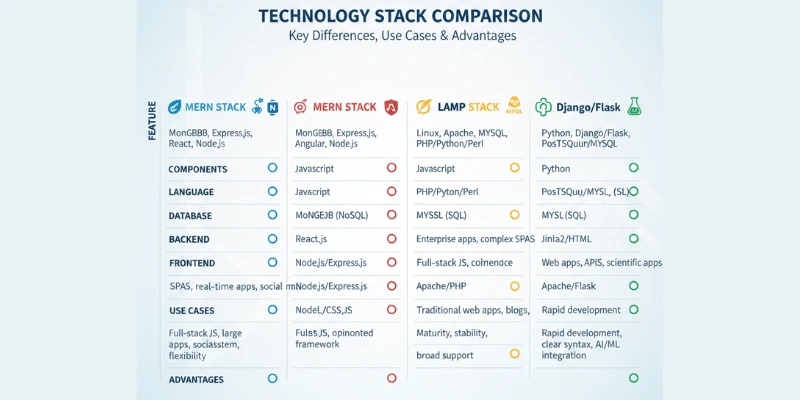
Understanding how MERN compares to other stacks helps in making informed decisions:
MERN vs. MEAN Stack
The main difference is Angular (MEAN) vs. React (MERN):
- React (MERN):More flexible, component-based, larger ecosystem
- Angular (MEAN):More opinionated, full framework, built-in features
MERN vs. LAMP Stack
LAMP (Linux, Apache, MySQL, PHP) is a traditional stack:
- MERN:Modern, JavaScript-based, better for real-time applications
- LAMP:Mature, widely used, better for traditional web applications
MERN vs. Django/Flask (Python)
Python-based stacks offer different advantages:
- MERN:JavaScript throughout, better for real-time apps, larger frontend ecosystem
- Django/Flask:Python's simplicity, better for data science integration, strong backend framework
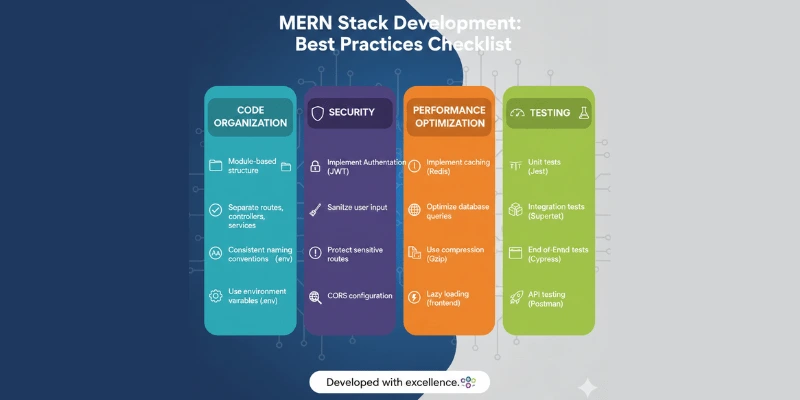
Best Practices for MERN Stack Development
Following best practices ensures your MERN stack application is maintainable, scalable, and secure:
Code Organization
- Separate concerns (models, controllers, routes, middleware)
- Use consistent naming conventions
- Implement proper folder structure
- Write reusable components and functions
Security
- Implement authentication and authorization (JWT, OAuth)
- Validate and sanitize user inputs
- Use HTTPS for all communications
- Implement rate limiting
- Protect against common vulnerabilities (XSS, CSRF, SQL injection)
- Use environment variables for sensitive data
Performance Optimization
- Implement database indexing
- Use pagination for large datasets
- Optimize React components (memoization, code splitting)
- Implement caching strategies
- Use CDN for static assets
- Optimize images and assets
Testing
- Write unit tests for components and functions
- Implement integration tests for API endpoints
- Use end-to-end testing for critical user flows
- Maintain good test coverage
Common Challenges and Solutions
MERN stack development comes with its challenges. Here are common issues and solutions:
State Management Complexity
Challenge:Managing state in large React applications can become complex.
Solution:Use state management libraries like Redux, Zustand, or React Context API for complex state.
Database Schema Design
Challenge:Designing effective MongoDB schemas without traditional relationships.
Solution:Understand embedding vs. referencing, design for query patterns, and use Mongoose for schema validation.
API Design
Challenge:Creating well-structured, RESTful APIs.
Solution:Follow REST principles, use consistent naming, implement proper HTTP methods, and document APIs.
Conclusion: Building Your Next Project with MERN Stack
The MERN stack offers a powerful, modern solution for building scalable web applications. Its full-stack JavaScript approach, combined with excellent performance and a rich ecosystem, makes it an ideal choice for many projects.
Whether you're building an e-commerce platform, a social media application, or a custom web application, the MERN stack provides the tools and flexibility you need to succeed.
However, MERN stack development requires expertise and experience to implement correctly. AtPyramiqSoft, our team of experienced developers specializes in MERN stack development, helping businesses build robust, scalable applications that drive results.
Our services include:
- Custom MERN stack application development
- API development and integration
- Frontend development with React
- Database design and optimization
- Application maintenance and support
- Performance optimization
- Security implementation
Led byKhawar Saleem Qamar, our team combines technical expertise with business understanding to deliver solutions that meet your specific needs.
Ready to build your next web application with MERN stack?Contact PyramiqSoft today:
- Phone:+923211802109
- Email:company@pyramiqsoft.com
- Website:https://pyramiqsoft.com
Let us help you leverage the power of MERN stack to build applications that scale with your business and delight your users. Get in touch today for a free consultation on your project.